
The Good Ones
on religion lost, passivity, and my Nani

When I came foot-first out of my mother, my Nani was overjoyed. In Guyana, where she came from, breeched Hindu babies are believed to have special healing powers. At family gatherings, she would tug on my hand and guide me to another room. “Nani’s back is sore baba. Can you put your foot on it?” Usually I would roll my eyes and, giggling, I’d rub my foot up and down her back as she crouched gingerly on the floor. When we were done, I’d help her up and she’d give me a big hug. “Thank you baba, much better!”
Nani had a lot of superstitions like this – don’t walk over a child’s outstretched legs or you’ll stunt their growth, don’t wear your hair in a long ponytail at night or someone will grab it and steal you. My cousins and I spent a lot of time with Nani when we were kids and eagerly followed these codes, in the sanctity of her home at least. Whenever I echoed them to my mother back at home she would scoff. Smiling, she’d say, “Nani is a worrywart honey.” It’s true that Nani was a wary woman, spending a lot of time in her little condo dwelling endlessly about sickness, death, war, and local tragedies. In the off moments, her true disposition would etch itself onto her face – mouth and eyebrows downturned, eyes wide, forehead crinkled. “Mommy why do you look so sad?” my mother would jest, “Fix your face!”
She thinks I inherited Nani’s disposition, concerned that I’ll also settle into this worried state as I get older. But really, anyone who has lived the life that Nani had would be wary of the world around them – forced to make sense of life’s hardships in whatever way they can.
Guyana is a peculiar country. It’s the only English-speaking nation in South America and home to a majority-Indian population, who were brought there during the slave trade as “indentured servants”. Hinduism is its second biggest religion, and informs much of the country’s aesthetic and cultural idiosyncrasies. Nani was born a Hindu, in a small Guyanese village called Golden Grove to a mother who died in childbirth and a philandering father. Nani worshipped him, referring to him as “daddy” well into her old age. Early on, Nani and her siblings were abandoned by their father, being separated into different homes and forced more or less to raise themselves. When her father remarried, she suffered consistent abuse from her new step-mother. Yet despite this, she forged a loving relationship with her young half-siblings – opting, a child herself, to help raise them. When she approached her teen years, Nani was married off to my Nana. As a child, he had been orphaned and homeless and, like so many men in Guyana at the time, he developed a preternatural interest in alcohol. They had five children together and, against her conservative community, she left him and chose to raise them all on her own. Every morning she pressed and bleached their shirts for school, and embarked on the long journey to the market where she worked, with a heavy basket of mangos balanced on her head.
My mother has always said someone should write a book about Nani’s life. It’s one that’s full of unthinkable tragedies and also, like any good story, miracles. Among the greatest miracle, Nani would tell you, is the fact that she and her children moved to Canada. To us, it’s a classic immigration story. But to them, one of the poorest families in their village, it’s a marvel they ever made it out. Leaving was proof to their community that they were never nothing. That my mother and her sisters were not the “fatherless whores” people so often whispered about as they passed in the street. That my uncle, treated like a dog by the adults around him, would amount to something incredible.
Those who grow up in abjection have a lot more to prove. Nani and her children hold immense pride in the way they appear to others. They may have lived in a house on stilts and slept together in one room on the floor, but their home was always clean. Nani was immaculately dressed. Until her very last days on this earth, even through the fog of her dementia, she insisted on having her nails and lips painted. This past Christmas, my aunt says that when Nani looked in the mirror before dinner, in gold earrings and a handsome red cashmere sweater, she smiled to herself and said, “I look pretty.” She passed away a week later.
Nani was a devout woman. Every morning she woke up at 5 and knelt before the altar in her tiny closet. We would kneel beside her and watch as she rotated the mala in her hand, praying. For eighty-seven years, Nani prayed. And never had I understood the power of this commitment, until her funeral.
To honour Nani, the funeral had to be done exactly as our religion intended it. Nani had to be dressed in her favourite white sari, covered elegantly in pinda and little pieces of gold. A series of her favourite bhajans were to be played before the funeral proceedings. Immediate family was required to perform an aarti over her, sprinkling pink and purple flowers into her coffin. My uncle and his son sat before the pandit and performed an elaborate series of rites, shifting around on a white sheet that had been laid out on the floor while the rest of us sat in chairs. She was to be carried by all her male kin, her coffin ritualistically lowered and lifted on the way to the crematorium. The men’s arms were shaking by the end, but their expressions were still.
Following the funeral, there were three Shradh pujas. The ten-day, the thirteen-day, and the “year work” as we call it. With the approval of our pandit, my family bumped the year work up to four months after the funeral, granting my Nani’s soul its final passage rather than letting her linger for a year. My uncle, her only son, was instructed by the pandit to abstain from a considerable number of foods, including meat and salt, for the thirteen days of mourning. No alcohol was to be consumed either. The night before each puja, my mother and her sisters had to stay up and prepare the food so it would be fresh for the morning. Each puja started at dawn, and necessitated a great deal of planning, negotiating with the pandit, and purchasing of the required materials.
I was tasked with writing her eulogy, and ran into many obstacles when consulting with my aunt. For her, the goal of the piece was to honour each and every person who entered Nani’s life with the upmost respect, regardless of whether they deserved it. See, Nani’s strict religiosity not only influenced her superstitions; it also effected a greater system of belief which determined the way she interacted with others. Something that was remarked upon over and over again at her funeral was that Nani was a woman who extended grace to everyone she knew – no matter who they were, or what they had done.
Respect came as a great challenge, because there are countless people who have deliberately harmed my family over the years. When we sat down for the thirteen-day puja, I watched each one of these people and their children file through the door. I watched as my uncle gave the aarti to them, bowing at the feet of a woman who chained him to a tree for twelve hours when he was eight. I watched my aunt help another to the bathroom, who once made her and my mother eat animal shit. Time and time again in her lifetime, Nani let these people stay in her home, fed them food and lent them money. And they always asked more of her. When her memory began to go and she had to move out, one of them called her and asked, “Can I have your condo?” At the puja, my cousins and I were indignant. “Why did you let them come?” And the response was always the same - this was not about us. It was about Nani, and Nani was a woman who practiced forgiveness.
Without Nani, my family argued about respect and civility. Whether we should allow the people who have hurt us back into our lives, let them break bread in our homes. They would come to my aunt’s house and fill their Tupperwares with food that she and her sisters stayed up all night to cook. They would hold their heads high in the air and give pitying nods when we greeted them, their shawls wrapped tightly around their shoulders. Without Nani, my cousins and I feared we’d have to negotiate a new code to live by, because it didn’t feel right.
There is something vicious about the way Nani was taken from us. As I watched her in the hospital, gasping in pain with every breath for seven days, I felt angry. How could a woman who had suffered so greatly from the very moment she entered this world, who already paid her due, be repaid in this way? When we came back from the hospital, my dad and I sat on the couch. “She didn’t deserve it,” I said, shaking. He looked at me. “No, she didn’t.”
Since then, a question has been rolling around in my head. At the end of the day, what did Nani’s forgiveness amount to?
The pujas were difficult. Everyone had stopped drinking – but they had also stopped eating and sleeping too. My mother and her siblings stayed at my aunt’s house, the house Nani lived in during those final few years, and glided around it like zombies. They sat on the couch and stared off – my uncle playing her bhajans on the TV for hours on end. This was one of the most dreaded moments in the history of my family, and now we were living it. Yet there was an odd sense of calm.
Something much greater than grief was happening here, because Nani was more than a grandmother. She was a mythological figure – and it became clear in the preparations for her funeral that carrying out her myth, grasping that flag and passing it along, was imperative. My family has always been tightly knit, but in these weeks I came to see a different side of them. The true weight of Nani’s matriarchal presence was felt by everyone – and the strict ethos that pervaded the atmosphere during this time made me feel something I’ve never felt before as a person who grew up in the West. That I was a part of some larger project, something tethering me to a greater whole. To be told so frequently “this is how we do it”, “this is what we believe” evoked a sense of community and tradition in me that had been missing for a long time.
When I participated in my Nani’s funeral, I was confronted by the idea that I may be encumbered by the Western ideals I was raised in. Put simply, I am a remarkably selfish person. I argued with my mother about going to the house for wake everyday, and went to bed while she and her sisters cooked poori. So little is expected of me and my cousins that my aunt actually praised us for driving to Walmart to buy the puja materials, and for buying pizza one of the thirteen nights. My life in Canada has been made easy, but in a small way I feel I may be worse for it. On this path that I’m on, I’m not sure I’ll have anything to instil in my kin the way Nani had. I worry they won’t know how to help each other. Outside of my family, I am congratulated, even rewarded, for acting against tradition, against altruism and generosity. What duty does anyone owe to each other in a place where selfishness is a virtue?
As the years have passed, and especially in the years that Nani was no longer able to care for herself, my family lost our faith. We stopped hosting pujas, I stopped praying at night, and we congregated less. When we did congregate, we drank. Drinking became tradition, and our drinking got heavier and heavier until tragedy slapped us in the face just last year. In our gatherings as of late, it felt like there was no longer some bigger activity, no collective purpose. Getting together as we did for the pujas restored something that had elapsed. We joked around, helped each other, sang, hugged. Most importantly, my cousins and I felt the pull of duty which a lifetime in Canada has inured.
It's easy to think, as I have many times before, that my family has no backbone. I’ve seen the way people speak to us. They speak with a harshness and condescension that we would never use with each other, even in our worst moments. Always, we repay it with an earnest smile. We continue to let evil people into our homes. We do not assert ourselves.
But asserting oneself was never a pursuit for Nani. There are so many times Nani or her children could have given up and turned their backs on the world, or sought revenge. And when I think about the injustice of Nani’s death, I try to remind myself of the impossible truth that truly devout people aren’t devout because they expect something in return.
In Pulphead, John Jeremiah Sullivan observes a group of young Evangelicals at a Christian rock festival who had experienced “terrific violence” in their lives. He remarks on the persuasion of their commitment to Jesus, whose breakthrough, for Sullivan, was “the aestheticization of weakness. Not in what conquers, not in glory, but in what’s fragile and what suffers – there lies sanity. And Salvation.” There is quiet power in unyielding benevolence. Despite everything that’s happened to us, despite generations of anguish and hardship, my family is happy. Nani suffered greatly at the end, but she left behind a legacy that knows what to do and how to love one another.
The final puja was just us. We hadn’t seen each other in a couple months, and showed up first thing in the morning looking rested. We sat on the white sheets, and as the pandit recited the prayers, we looked around at each other. My uncle, who had been sweating with anxiety during the first puja (it turns out avoiding salt for thirteen days doesn’t bode well when you’re diebetic), was smiling. I held my mother’s hand and noticed that, through the tears, she was smiling too. When we performed the aarti for the last time, drawing circles around a picture of Nani standing in the driveway, smiling in a blue sari, I cried hard. Just like when we covered her face in the hospital and sang Tvameva Mata, I knew that I wasn’t just saying goodbye to Nani.
On the thirteenth day I met Nani’s long-time friend Aunty Betty, who I had heard so much about over the years. Aunty Betty is a tiny, dark-skinned, distinguished woman with a strong Nebaclis accent. When my cousin and I drove her home that night, she insisted on showing us her little Pickering apartment, proudly touring her organized closets, pointing to the altar on her bedside table, and offering us treats from her purse. She also insisted on walking us out. And as I watched her wave at us through the window of her lobby as we drove away, I felt a surge of longing. That voice, those habits, would die out with Aunty Betty and Nani and others like them. Nani and Aunty Betty belong to a lost generation of Guyanese immigrants, who worked doggedly at the market and experienced hardships none of us could never fathom. They carried themselves like queens and spoke like mango merchants, and remained faithful that, one day, some higher power would guide them to salvation. I pray that it does.
Edited by Rosalind Sweeney-McCabe and Nico Piacenza
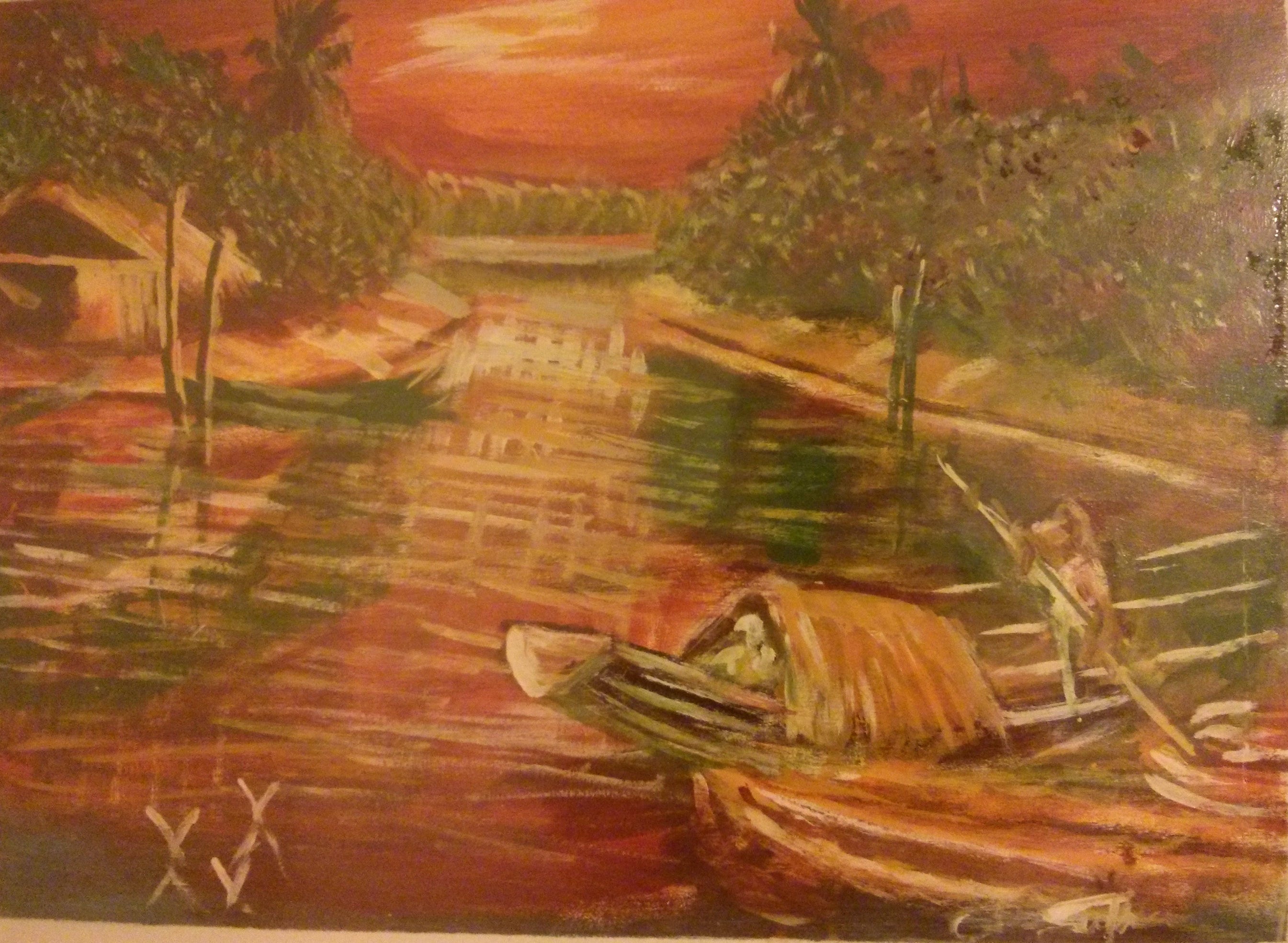
Image: Essequibo River, Claude Stevens
This was really beautiful. It was quite refreshing to hear a perspective of someone who grew up in that feels like an opposite side of the same coin.
I am from India also raised Hindu, grew up in India very much 'belonging' in the society and currently living in the 'West'. Left my country to seek the 'independence' and 'freedom from expectations/ duty'. Stopped praying and empowered myself with the values of the 'West'. Part of me feels entitled to this 'selfishness' as I had felt so suppressed in my home country for years by familial, cultural, societal and religious norms and expectations. Yet part of me recognises that I am definitely on my way to lose something (or have already) if I don't do something about it. It feels really difficult to manage these two paradoxes - duty and independence. Control and freedom. Closeness and space. And I feel so far I am at the first few seconds of pendulum. Swinging from one end to another. But hopefully I soon learn how to balance these ends before I lose something priceless.
It is really difficult to close this gap. To communicate and adjust and manage while also holding on to your agency. As its so subjective and there is no blueprint for it. But thank you very much for writing this, and for showing your perspective on what it feels like to come from the other side. I will be coming back to this write up again and again.
Thank you for writing this highly eloquent and meaningful personal essay Maia. It resonated with and moved me quite deeply especially with the lovely memories and connection you share with your Nani, and empathetic reflection on devotion and forgiveness. I really admire your rich appreciation for your Nani and family’s history as well as pride in their solidarity and perseverance. I also really respect the insight into Guyana, Hindu rituals and how the ripple effects of your Nani’s story across generations. Indeed I hope someone does write a book about her someday.
I wrestle with those sentiments in my own way seeing how secular and worldly my siblings, myself and cousins have become in comparison to the piety and observance I see in my mother’s and older relatives' traditionalist Catholic faith and upbringing. My parents are Hispanic immigrants, I frequently reflect upon my elusive relationship to my own heritage growing up working-class in a first-world country. As I grow up and become increasingly independent, I do feel that sense of melancholy in that creeping detachment and ambivalence toward the roots and traditions of my family’s elders. My grandmother passed away earlier this year, and my other grandparents have passed away in years past. At the wake for my grandma, I felt reminded of the enduring familial love and esteem I have for my clan and the communal bond we share that transcends whatever disinvestment or ambivalence I may have in our faith traditions or cultural identity. I choose to acknowledge the beauty in my mother’s family’s piety, even if I can’t participate in it the same way. I do my best to express daily gratitude and grace towards my mother and family members, being mindful of their humble past and the struggles they carry for us.
Thanks again for choosing to share your beautiful introspection with us.